
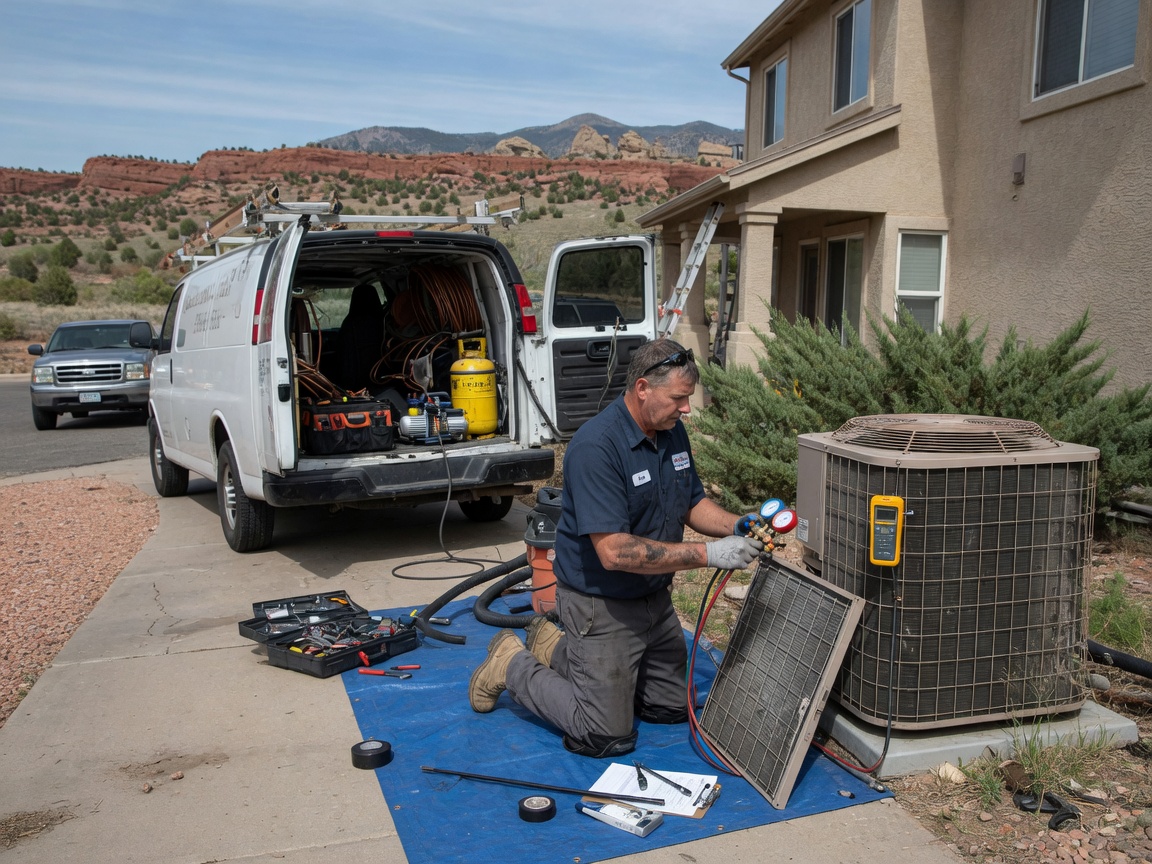
Castle Rock’s semi-arid climate produces constant fine dust that infiltrates condenser coils and evaporator fins, especially in homes built on the open terrain around The Meadows and Founders Village. Technicians see reduced airflow and higher head pressures within two seasons if coils are not cleaned properly. Older housing stock near Downtown Castle Rock often has R-22 systems that require careful leak detection and EPA-compliant recovery before any retrofit work begins.
Douglas County building practices place many units on south-facing roofs or tight side yards where afternoon sun and reflected heat from rock outcrops push systems past design limits. In these locations, capacitor and contactor failures occur earlier than in shaded Parker or Highlands Ranch neighborhoods. Repair calls spike after sudden temperature swings when snowmelt raises local humidity and strains older compressors.
Technicians carry manifold gauges, nitrogen for pressure testing, and OEM capacitors sized for the common 3- to 5-ton units found in Lone Tree and Castle Rock Outlets area homes. Every repair includes a static-pressure check across the evaporator because undersized returns in many 1990s builds create hidden performance issues that simple part swaps never fix.
Emergency service runs 24 hours because a single failed run capacitor on a 100-degree afternoon can push indoor temperatures past 85 degrees inside tightly sealed Douglas County homes within two hours.
Technician insight
In Castle Rock the thing that catches most people out with AC Repair is how fast fine dust from the semi-arid high plains loads the condenser coils on units sitting in the open lots around The Meadows. Homeowners change filters religiously but skip the annual coil cleaning, then wonder why the compressor overheats on the first 95-degree day.
Founders Village Compressor Failure
Homeowner in Founders Village reported the outdoor unit running nonstop yet indoor air staying warm. Inspection showed low refrigerant and a shorted compressor winding caused by years of restricted airflow from cottonwood debris. Nitrogen test confirmed no lineset leaks; the compressor and capacitor were replaced, system was recharged to factory spec, and static pressure was corrected by cleaning the return grille. Indoor temperature dropped to 72 degrees within an hour and the unit cycled normally through the evening.
AC Repair Services We Offer
✓Refrigerant Leak Repair
Locate and seal leaks in linesets common to homes in The Meadows, then recharge with the correct refrigerant blend while documenting recovery per EPA rules.
✓Compressor Replacement
Swap failed compressors on older R-22 and R-410A units found in Founders Village, including electrical checks and oil analysis to prevent repeat failure.
✓Condenser Coil Cleaning
Remove pollen, cottonwood fluff and road dust that accumulate on units near Castle Rock Outlets and Douglas County Fairgrounds, restoring airflow and lowering head pressure.
✓Capacitor and Contactor Service
Replace heat-stressed start and run capacitors plus contactors that fail faster in south-facing installations around Rock Park and Downtown Castle Rock.
✓Thermostat and Control Repair
Diagnose and replace malfunctioning thermostats or control boards that misread temperatures during rapid day-to-night swings typical in Douglas County.
AC Repair Cost in Castle Rock, CO
| Service | Typical Range | What Affects It |
|---|---|---|
| Diagnostic Visit | $125–$175 | Includes full electrical and airflow testing; credited if repair approved same day. |
| Capacitor Replacement | $180–$320 | Varies by dual-run vs single capacitor and access on roof or ground units. |
| Refrigerant Leak Repair | $350–$850 | Depends on leak location, refrigerant type, and whether lineset replacement is required. |
| Compressor Replacement | $1,400–$2,600 | Includes recovery, new capacitor, and system flush; higher on R-22 retrofits. |
Ranges are typical for Castle Rock, CO and confirmed with an exact written quote before any work starts.
How it works
- 1
Initial Diagnostic
Technician arrives, pulls error codes, measures static pressure, amperage and temperature split, then explains findings before any parts are ordered.
- 2
Component Isolation
Isolate the failed part—compressor, capacitor, TXV or coil—using nitrogen pressure testing and electrical diagnostics specific to the unit age and location.
- 3
Repair And Verification
Complete the repair, recover and weigh in refrigerant if needed, then run a full system performance test under load to confirm proper operation.
- 4
Final Walkthrough
Show the homeowner the replaced parts, review maintenance steps for local dust conditions, and schedule any follow-up filter or coil service.
Pricing
Upfront written quotes provided before any repair work begins; diagnostic fee credited toward approved repairs.